Parents often start looking for a pediatric dentist in Bangalore after a first tooth, a dark spot on a molar, a toothache at bedtime or a difficult appointment somewhere else. To choose well, compare four things: the dentist’s specialist qualification, how the team supports anxious or very young children, the preventive and restorative care offered, and practical factors such as location, appointment access and a clear written estimate. In this guide, our team at Little Pearls Dental Care in BTM Layout explains each of these, along with first visits, common treatments, costs and when to book, so you can compare any clinic with confidence.
Key takeaways
- Check the qualification. Look for an MDS in Pediatric and Preventive Dentistry, and ask for the dentist’s State Dental Council registration details.
- Judge child-friendliness by behaviour. How the team talks to your child and paces care matters more than cartoons or toys.
- The first visit is usually gentle. It is mainly a check-up, a conversation and prevention advice, not treatment.
- Anxiety is managed step by step. Behaviour guidance comes first for most anxious children. Sedation is assessed individually.
- Milk teeth matter. They support chewing, speech development and space for adult teeth, so decay should be assessed rather than ignored.
- Ask for a written plan and estimate. Book promptly for pain, swelling or injury.
In this guide
- How do you choose a pediatric dentist in Bangalore?
- Pediatric dentist vs general dentist: does your child need a pedodontist?
- What makes a dental clinic truly child-friendly?
- What happens at your child’s first dental visit?
- How does a pediatric dentist help an anxious child?
- Common pediatric dental treatments, explained simply
- Why milk teeth still need care, even though they fall out
- How much does a pediatric dentist cost in Bangalore in 2026?
- When should you book a pediatric dentist appointment?
- Comparing pediatric dentists in Bangalore: local options near BTM Layout
- Questions to ask before you book
- Frequently asked questions
How do you choose a pediatric dentist in Bangalore?
The right choice depends on your child’s age, the concern and how comfortable your child feels in a clinic. A toddler’s first check-up, a deep cavity in an anxious six-year-old and a nine-year-old’s bite concern each call for slightly different strengths. Choose a clinic before an urgent problem happens. Decisions about pain or injury are much easier when you already know who to call.
If you are new to specialist children’s care, our overview of pediatric dentistry for children explains the field. Our guide to what does a pediatric dentist do? covers the day-to-day role.
Use this checklist when you call or visit any kids dentist in Bangalore:
| What to check | Why it matters | What a good answer sounds like |
|---|---|---|
| Specialist qualification | Pediatric training covers children’s growth, behaviour and milk-teeth treatment. | “Your child will be seen by Dr X, who has an MDS in Pediatric and Preventive Dentistry.” |
| First-visit approach | The first visit can shape your child’s future confidence with dentists. | “The first visit is mostly about getting to know your child, then a gentle check.” |
| Anxiety support | Some children need more time. | “We go step by step and discuss options if your child needs more support.” |
| Treatments available | Helps you avoid an unnecessary referral for routine care. | “We offer preventive care, fillings, pulp treatment, crowns and habit and early orthodontic assessment.” |
| Cost transparency | Helps you avoid surprise charges. | “You will receive a written plan with estimated fees before we begin.” |
| Access and availability | School timings and Bengaluru traffic matter. | A clear booking route and appointment options that fit your family’s routine. |
Pediatric dentist vs general dentist: does your child need a pedodontist?
A pediatric dentist, also called a pedodontist, has completed a BDS and then a three-year MDS in Pediatric and Preventive Dentistry. This specialist postgraduate programme focuses on infants, children and teenagers. General dentists can treat children well. A pediatric specialist’s training, however, centres on children’s growth, behaviour and milk-teeth care.
Pedodontist: a dentist with specialist postgraduate training in children’s dental care, including prevention, milk-teeth treatment, dental injuries, behaviour guidance and early growth concerns.
What MDS training in pediatric dentistry covers
Under the Dental Council of India MDS Course Regulations 2017, the MDS is a three-year, full-time course at a recognised institution. Admission requires a BDS, state registration, a completed internship and the national entrance exam. The Pedodontics and Preventive Dentistry syllabus covers:
- Clinical pedodontics.
- Preventive and community dentistry applied to children.
- Chairside preventive schedules for high-risk children.
- Dental materials, radiology and informed consent.
In practice, this means training in cavity-risk assessment, pulp treatment, crowns for milk teeth, dental injuries, tooth eruption, early bite development, behaviour guidance and care for children with special healthcare needs. Not every child must see a specialist. Many children do well with a skilled general dentist.
When specialist pediatric care is especially helpful
A pediatric specialist can be particularly useful in these situations:
- Babies and toddlers, including first visits.
- Children with high anxiety or a difficult past appointment.
- Several cavities or deep decay in milk teeth.
- Dental injuries from falls, sport or play.
- Thumb sucking, mouth breathing or bite concerns.
- Children with additional medical, developmental or sensory needs.
How to check a dentist’s qualification
- Ask which individual dentist will examine your child, and what their exact qualification is.
- Look for “MDS Pediatric and Preventive Dentistry” or “MDS Pedodontics”.
- Ask for their State Dental Council registration number and the issuing state. You can contact the Karnataka State Dental Council registrar’s office to ask about its current verification process.
Under the National Dental Commission Act 2023, a National Register for Dentists will record each dentist’s recognised qualifications, and the register is intended to be publicly accessible. At Little Pearls, our pediatric care is led by Dr. Neeraja Raju, an experienced pediatric dentist who has been practising since 1992.
What makes a dental clinic truly child-friendly?
A child-friendly dental clinic is defined by how the team behaves. That means speaking to your child in simple words, explaining before doing, allowing breaks, praising effort and keeping you informed. Bright walls and screens may help, but the clinical approach is what makes a visit feel safe.
| Looks child-friendly | Is child-friendly |
|---|---|
| Cartoon murals | The dentist speaks to your child first, not only to you. |
| Toys in the waiting area | Short waits, a calm reception and no unnecessary rushing. |
| “Gentle care” claims on a website | Tell-show-do before each step. |
| Kids’ TV on the ceiling | Breaks and an agreed stop signal are respected. |
| Gifts after the visit | Honest praise for effort, including for partial visits. |
When you compare clinics, also ask:
- Can a parent stay in the room with the child?
- How are instruments cleaned and sterilised?
- Is the team prepared for a medical emergency?
At Little Pearls, pediatric dentistry is provided from our BTM Layout centre. You can see how we have set up our child-friendly pediatric dental clinic and read about the dental care designed for children that guides each visit.
What happens at your child’s first dental visit?
The American Academy of Pediatric Dentistry (AAPD) recommends the first dental examination when the first tooth appears, and no later than the first birthday. The Indian Society of Pedodontics and Preventive Dentistry has adopted the same guidance. A 2019 editorial in its journal notes that this early visit is often neglected in India.
Early visits matter here. A 2022 meta-analysis estimated that nearly one in two preschool children in India has early childhood caries (tooth decay).
When should you book the first visit?
Aim for the time the first tooth appears, and no later than the first birthday. Book sooner if you notice:
- White or brown spots on the teeth.
- An injury to the mouth.
- Feeding concerns.
If your child is older and has never seen a dentist, there is no need to feel guilty. Today is a good day to start.
Step by step: what to expect
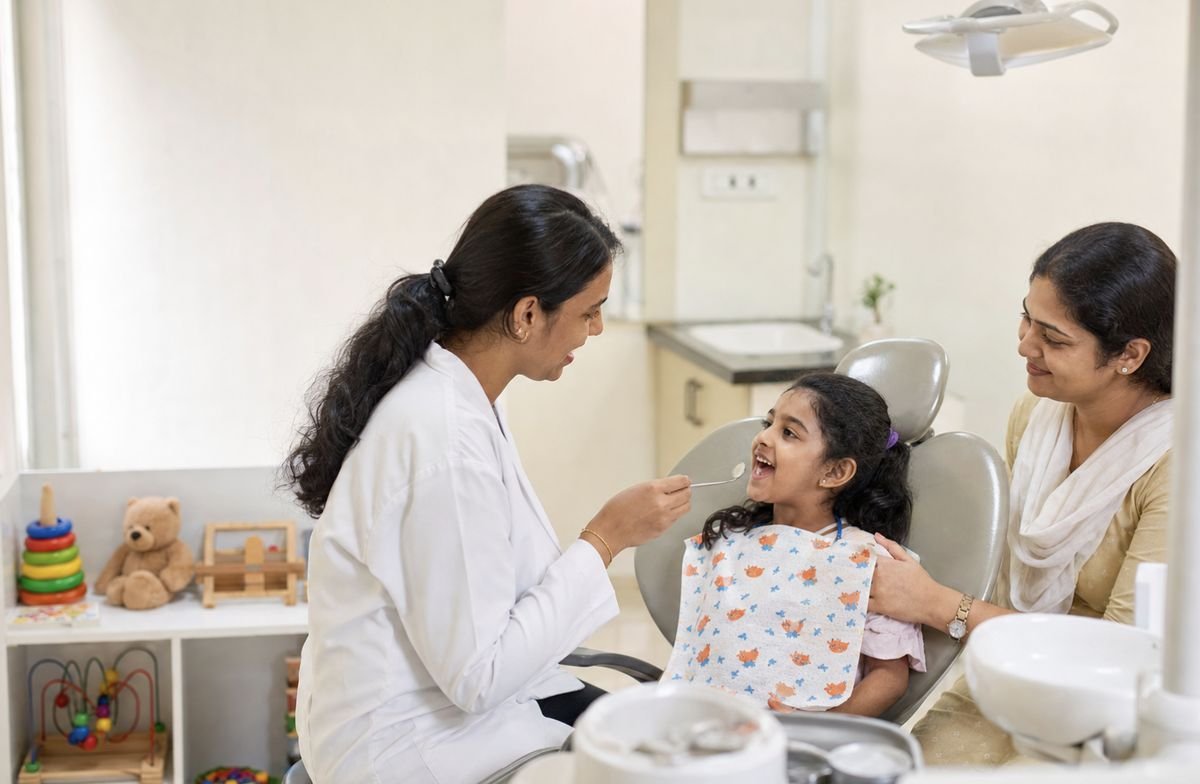
- Welcome and settling in. Your child gets a few minutes to explore the room and meet the team.
- Conversation. We ask about medical history, feeding, snacking, brushing, toothpaste, and thumb sucking or pacifier use.
- Gentle examination. We look at the teeth, gums and bite, and assess cavity risk.
- X-rays only if clinically needed. We always explain why first.
- Home-care advice. This covers brushing and diet suited to Indian routines. The American Academy of Pediatrics and AAPD advise twice-daily brushing with fluoride toothpaste. Use a smear, about the size of a grain of rice, for children under three and a pea-sized amount from three to six. Supervise brushing and encourage your child to spit, not rinse. Fluoride levels vary between Indian toothpaste brands, so check the pack and ask your dentist.
- Next steps. If anything needs attention, we discuss the options calmly.
You can read more about your child’s first dental visit on our website.
How to prepare your child and yourself
Do:
- Book away from nap time and mealtimes, especially for toddlers.
- Use simple, positive words such as “The dentist will count your teeth”.
- Read a picture book or play “dentist” at home.
- Bring previous X-rays, medicine details and a favourite comfort item.
- Stay calm. Children pick up on your mood.
Avoid:
- Promising “it will not hurt”.
- Mentioning injections or drills.
- Using the dentist as a threat.
For more ideas, see how to prepare your child for a dental visit.
How does a pediatric dentist help an anxious child?
Pediatric dentists usually start with behaviour guidance. They explain each step in simple words, show the instrument, then do the step, while praising effort and allowing breaks. If a child still cannot cope, the dentist may discuss options such as laughing gas. That decision comes only after assessing the child’s health, age, anxiety level and treatment needs.
Gentle techniques most children respond to
The AAPD Behavior Guidance recommendations describe several basic techniques:
- Tell-show-do. Explain the step at your child’s level, demonstrate it in a non-threatening way, then do exactly what was explained.
- Positive reinforcement and descriptive praise. For example, “You kept your mouth open so well.”
- Distraction. Stories, counting or music.
- Desensitisation. Gradual familiarisation over one or more short visits.
- Short breaks. A pause during a stressful moment can help before anything more is considered.
Some children will still feel worried or cry, and that is normal. The aim is calm, respectful care, not a promise that there will be no tears.
Is laughing gas (nitrous oxide) right for every child?
Nitrous oxide is breathed through a small nose mask and helps a child relax while staying awake. It is not routine, and it does not suit every child. According to AAPD guidance on nitrous oxide, it may not be suitable for children with:
- A cold, sinus infection, allergies or anything else that blocks nasal breathing.
- A recent middle-ear infection.
- Recent severe head or neck injury.
- Certain rare medical conditions or treatments.
Asthma on its own is not a reason to rule it out. Before nitrous oxide is used, your dentist should explain its benefits, risks and alternatives.
| Level of support | What it is | When it may be considered |
|---|---|---|
| Behaviour guidance | Communication-based techniques. | First choice for most children. |
| Nitrous oxide (laughing gas) | A gas breathed through a nose mask to help the child relax while awake. | Mild to moderate anxiety, where nasal breathing and medical history allow. |
| Deeper sedation or general anaesthesia | Higher-level options that need formal monitoring and trained anaesthesia personnel. | Extensive treatment, significant needs, or when other approaches are unsuitable. These are arranged where such facilities exist. |
What if your child cannot finish treatment that day?
This is not a failure. The dentist may stop, make the tooth comfortable and plan another visit. Forcing treatment can make a child more fearful, which makes every future appointment harder. A partial visit that ends calmly can help build confidence for future appointments.
Dental care for children with special needs: what to ask
The AAPD recommends individualised prevention, behaviour guidance, sensory adaptations and coordination with a child’s medical team. Before booking, ask:
- Can we have a pre-visit call to share our child’s needs?
- Are quieter appointment times available?
- How do you adapt for sensory sensitivities to light, sound or touch?
- Can a caregiver stay with the child?
- Will you coordinate with our pediatrician or therapist?
- Where would you refer us if hospital-based care is needed?
Learn more about dental care for children with special needs at Little Pearls.
Common pediatric dental treatments, explained simply
Every child is different. A treatment should be recommended only after an examination. Here is what each common option does, why it may be suggested and what you can ask.
| Treatment | Type | What it does | May be recommended when |
|---|---|---|---|
| Fluoride treatment | Preventive | Helps strengthen enamel. | Higher cavity risk or early white spots. |
| Dental sealants | Preventive | Cover deep grooves on back teeth. | Newly erupted permanent molars have deep grooves. |
| Tooth-coloured filling | Restorative | Repairs a cavity. | Small to moderate decay. |
| Pulpotomy or pulpectomy | Restorative | Treats the pulp inside a milk tooth. | Deep decay has reached the pulp. |
| Stainless steel crown | Restorative | Caps and protects a weakened milk tooth. | After pulp treatment or large decay. |
| Extraction and space maintainer | Restorative and developmental | Removes a tooth that cannot be saved and may hold the space. | The tooth cannot be saved and space loss is a concern. |
| Habit appliance or early orthodontic assessment | Developmental | Helps address persistent habits and monitors bite development. | Thumb sucking, mouth breathing, crowding or crossbite concerns. |
You can see the full range of our pediatric dental services on our website.
Preventive care: fluoride, sealants and diet advice
Fluoride varnish is painted onto the teeth in a few seconds. The AAPD supports it for young children at risk of cavities, often every six months, or more often for higher risk.
Sealants are thin protective coatings that fill the deep grooves on back teeth, where food tends to collect.
Remineralising pastes may be suggested for early enamel changes, depending on your child’s needs. Read about fluoride treatment for kids and tooth decay prevention for children.
Diet advice matters as much as any treatment. Sweetened milk at bedtime, biscuits between meals, sticky snacks and festival sweets can increase cavity risk. Frequent exposure to sugary foods and drinks can be particularly important. Your dentist will suggest a check-up interval based on your child’s individual risk.
Fillings for cavities in milk teeth
Fillings repair the hole left by decay. Tooth-coloured materials are often used. The best choice depends on which tooth is affected, how large the cavity is and how well your child can sit for treatment.
A good question to ask: “Can this be monitored with prevention, or does it need filling now?” Some very early lesions can be watched closely. Established cavities often need treatment.
Pulpotomy and pulpectomy: treating the nerve of a milk tooth
The pulp is the soft inner part of a tooth that contains nerves and blood supply. When decay reaches it, a milk tooth may still be saved.
- Pulpotomy removes and treats the upper part of the pulp. According to the AAPD Pulp Therapy guidance, it suits teeth with an exposed but otherwise healthy or mildly inflamed pulp and no signs of infection.
- Pulpectomy cleans and fills the whole pulp space. It is used when the pulp is irreversibly inflamed or has died.
In both cases, the aim is to keep the tooth until it falls out naturally. A crown may be recommended afterwards to protect the tooth.
Stainless steel crowns: why a milk tooth may need a cap
A stainless steel crown is a pre-formed cap that fits over a weakened back milk tooth. The AAPD recommends these crowns after pulp treatment, for large or multi-surface decay, and for children at high cavity risk, where they tend to last longer than large fillings. The crown usually sheds with the milk tooth.
Extractions and space maintainers
Removing a tooth may be the right choice when it cannot be saved. If a back milk tooth is lost early, the neighbouring teeth may drift into the gap and affect the space available for the adult tooth underneath. A space maintainer is a small appliance that holds that space.
Not every early tooth loss needs one. Your dentist will decide based on your child’s age, which tooth was lost and how the adult teeth are developing.
Thumb sucking, mouth breathing and early orthodontic assessment
Sucking habits are normal in babies and young children, and many stop naturally. The AAPD notes that prolonged habits are linked to open bites and crossbites. It encourages parents to guide children to stop by around age three. Habit-breaking appliances for kids can help when a habit continues as permanent teeth arrive.
Frequent mouth breathing or snoring is worth mentioning to your dentist. Mouth breathing may contribute to changes in jaw and bite development, although it is not the only cause. Sometimes a pediatrician or ENT specialist may also need to take a look.
The American Association of Orthodontists recommends a first orthodontic check-up by age seven. An early assessment may simply mean monitoring rather than braces straight away. At Little Pearls, orthodontics and Invisalign are available at the same centre, so early orthodontic assessment in Bangalore can happen alongside your child’s pediatric care.
Why milk teeth still need care, even though they fall out
Milk teeth are worth caring for because they contribute to chewing, speech development and space for adult teeth. According to the ADA primary tooth development chart, the back milk molars usually stay until around ages 10 to 12. Untreated decay can lead to pain, infection and difficulty eating, which may affect sleep, school and mood.
Healthy milk teeth support:
- Chewing and nutrition.
- Speech development.
- Space for permanent teeth.
- Comfort, sleep and concentration at school.
Cavities in children are common, and they are nothing to feel ashamed about. Acting early can keep treatment simpler and shorter.
How much does a pediatric dentist cost in Bangalore in 2026?
Pediatric dental costs in Bangalore vary with your child’s needs: the number of teeth involved, the materials used, X-rays, whether pulp treatment or a crown is needed, and any sedation. Ask for a written treatment plan with an itemised estimate before treatment begins, so you can compare options fairly.
What affects the cost
- Consultation and examination.
- X-rays, if needed.
- The number and size of cavities.
- The choice of material.
- Pulp treatment and crowns, which are often priced separately.
- Sedation, where it is used.
- Review and follow-up visits.
Indicative Bangalore price ranges
The figures below are third-party market estimates for 2026, not clinic quotes. Actual fees vary by clinic, treatment plan and materials used.
| Treatment | Bengaluru estimate (teeth.in) | Tier-1 city estimate (Toothtribe) |
|---|---|---|
| Child check-up | Rs 200 to 4,200 per visit | Not given |
| Fluoride varnish | Rs 300 to 3,200 per session | Rs 500 to 1,500 per arch |
| Pulpotomy | Rs 850 to 6,900 per tooth (crown extra) | Rs 1,500 to 4,000 |
| Pulpectomy | Rs 850 to 12,500 per tooth | Not given |
| Stainless steel crown | Rs 1,300 to 8,500 per tooth | Rs 2,000 to 4,500 |
Questions to ask about your estimate
- Are X-rays included?
- Are pulp treatment and the crown priced separately?
- Are review visits charged?
- What are the alternatives, and how do their costs compare?
- What payment, EMI or insurance options are available?
When should you book a pediatric dentist appointment?
Book a routine check-up by your child’s first birthday, then at the intervals your dentist recommends. Book within a few days for a visible cavity, sensitivity or a bite concern. Seek urgent dental advice for toothache that affects sleep, facial swelling, fever with tooth pain, or an injury that breaks or knocks out a tooth.
| Book a routine visit | Book within days | Seek urgent dental help |
|---|---|---|
| First tooth or first birthday | Visible dark spot or hole | Toothache waking your child at night |
| Never had a check-up | Sensitivity to cold or sweets | Swelling of the face or gums, or pus |
| Frequent sweet snacks or drinks | Food getting stuck, or bleeding gums | Fever with dental pain |
| Questions about thumb sucking or mouth breathing | Chipped tooth without pain | Knocked-out, pushed-in or broken tooth |
| Questions about crowding or the bite | Delayed loss of milk teeth | Bleeding that does not stop after an injury |
If your child has difficulty breathing or swallowing, or swelling is spreading quickly, go to the nearest hospital emergency department straight away. The AAPD treats spreading swelling that could affect the airway as a true emergency.
Dental injury or toothache: what to do right now
- Check whether the knocked-out tooth is a milk tooth or a permanent tooth. Children usually start losing milk teeth around age six.
- Do not put a knocked-out milk tooth back. The International Association of Dental Traumatology (IADT) advises against replanting it, because doing so may harm the developing adult tooth.
- For a knocked-out permanent tooth, act quickly. Handle the tooth carefully by the crown rather than the root, avoid scrubbing it, keep it moist and see a dentist immediately. Time matters, as described in the IADT avulsion guidance.
- For toothache, keep home care simple. Rinse with warm water, and use pain relief only as advised by a doctor or pharmacist for your child’s age. Then book a dental visit.
Comparing pediatric dentists in Bangalore: local options near BTM Layout
This is not a ranking. It is a starting list for parents searching for the best pediatric dentist in Bangalore near BTM Layout. We have started with Little Pearls so you can clearly see our own offering. Other clinic details come from public listings and may change, so please confirm them directly. Use the checklist above to compare any clinic fairly, including when you read pediatric dentist Bangalore reviews.
1. Little Pearls Dental Care, BTM Layout
Little Pearls Dental Care was founded in 2013 in BTM 2nd Stage. Our pediatric care is led by Dr. Neeraja Raju, who has been practising dentistry since 1992 and trained in Pedodontics at Oxford Dental College. Pediatric dentistry, orthodontics, adult dental care and other specialties are available at the same centre, which suits families who want everyone’s care in one place.
| Detail | Little Pearls Dental Care |
|---|---|
| Lead pediatric dentist | Dr. Neeraja Raju, MDS, practising since 1992 |
| Established | 2013 |
| Location | No 46, 1st Floor, 1st Main Road, 7th Cross Road, Mico Layout, BTM 2nd Stage, BTM Layout, Bengaluru 560076 |
| Pediatric care | Specialist pediatric dental care for children |
| Orthodontics | Braces and Invisalign |
| Other specialties | Root canal treatment, crowns, implants, cosmetic dentistry, oral surgery and gum care |
| Booking | +91 98807 02525 |
Best suited for:
- Families seeking specialist-led pediatric care.
- Children who may need early orthodontic monitoring in the same centre.
- Parents who prefer family dental care under one roof.
Learn more about our pediatric dentist in Bangalore team, or read about our care as a child dentist in Bangalore.
2. Teethling Dental Care, BTM Layout
Teethling Dental Care is in BTM Layout. Its Practo listing names Dr. Swati Kedia (BDS, MDS Pedodontics), shows a 5.0 rating from 815 ratings, and lists wheelchair access. Confirm current hours and the consultation fee by phone.
3. Sabka Dentist, BTM Layout
The Sabka Dentist branch in BTM 2nd Stage (First Floor, No. 773, 7th Cross, 16th Main) lists pediatric dentistry for children under 14 on Practo, where the branch is rated 4.5 from 41 ratings. When booking, ask who will see your child and what their pediatric qualification is.
4. Perfect Dental Studio, BTM 2nd Stage
Perfect Dental Studio is at 43, 7th Main, 12th Cross Road, Mico Layout, BTM 2nd Stage. Public listings include pediatric treatment among its services. Ask which dentist will see your child, and about their qualification and approach to children.
Looking for a pediatric dentist in Indiranagar, Whitefield or elsewhere in Bangalore?
Little Pearls is in BTM Layout, South Bengaluru. If you live in Indiranagar, Whitefield or across the city, a clinic near you may be more practical for routine check-ups. Searching “pediatric dentist Bangalore near me” or “kids dentist near me” is a reasonable place to start. Some families do travel for specialist treatment or orthodontic monitoring. Whichever children’s dentist in Bangalore you consider, the same checklist applies.
Questions to ask before you book
Keep this list handy when you call any clinic:
- Who will examine my child, and what is their qualification?
- How do you handle a first visit for a baby or toddler?
- What happens if my child is scared or refuses the chair?
- Can I stay in the room?
- Do you offer laughing gas, and how do you decide whether it is suitable?
- Do you support children with special needs or sensory sensitivities?
- Will I receive a written treatment plan and estimate?
- What are the alternatives to the recommended treatment?
- What should I do if my child has pain or an injury after hours?
- Do you have appointments that fit around school?
Book your child’s visit at Little Pearls Dental Care, BTM Layout
Whether it is a first visit, a routine check-up or a specific worry, our pediatric team will examine your child gently. We will explain what we see and talk you through what, if anything, needs doing before any treatment begins.
What to bring:
- Previous dental records or X-rays.
- Details of any medicines and health conditions.
- Your questions, written down.
- A favourite comfort item, if it helps.
Little Pearls Dental Care No 46, 1st Floor, 1st Main Road, 7th Cross Road, Mico Layout, BTM 2nd Stage, BTM Layout, Bengaluru, Karnataka 560076
Book an appointment: call +91 98807 02525
Frequently asked questions about pediatric dentists in Bangalore
What is the best age for my child’s first dental visit?
The AAPD, whose guidance the Indian Society of Pedodontics and Preventive Dentistry has adopted, recommends the first visit when the first tooth appears and no later than the first birthday. Book sooner if you notice white or brown spots, a mouth injury or feeding concerns.
What is the difference between a pediatric dentist and a pedodontist?
There is no difference. Both terms describe a dentist who has completed an MDS in Pediatric and Preventive Dentistry (also called Pedodontics), a three-year specialist programme in children’s dental care.
Can I stay with my child during the appointment?
Policies vary between clinics and sometimes depend on the child’s age or the procedure. Ask when you book. Many young children feel safer when a parent is close by, and a good team will explain how they handle this.
What if my child cries or refuses to sit in the dental chair?
This is very common. A pediatric team will slow down, use tell-show-do, offer breaks and, when appropriate, split care into shorter visits. The goal is to build your child’s trust over time.
Is laughing gas safe for children?
Nitrous oxide may be well tolerated when a child’s suitability is assessed and the gas is properly given and monitored. It is not suitable for every child, for example when nasal breathing is blocked. Your dentist should discuss its benefits, risks and alternatives with you first.
Does every anxious child need sedation?
No. Many anxious children respond well to behaviour guidance, gradual familiarisation and time. Sedation is considered only after an individual assessment.
Does a cavity in a milk tooth need treatment?
It should always be assessed. Milk teeth support comfort, eating and space for adult teeth, and some stay until ages 10 to 12. Some very early lesions can be monitored with preventive care. Established cavities often need treatment.
How much does a child’s dental check-up cost in Bangalore?
It varies by clinic, and by whether X-rays, fluoride or other services are needed. Third-party estimates for Bengaluru in 2026 range widely, from around Rs 200 to Rs 4,200 per visit. Ask for an itemised estimate.
When should I worry about thumb sucking or mouth breathing?
Mention it to your dentist if a sucking habit continues as permanent teeth come in, or if your child often breathes through the mouth or snores. An assessment is sensible, and there is no need for alarm.
How do I book a pediatric dentist near me in BTM Layout?
Call Little Pearls Dental Care on +91 98807 02525 to book a first visit, check-up or consultation. Our pediatric team will explain findings and options before any treatment.